
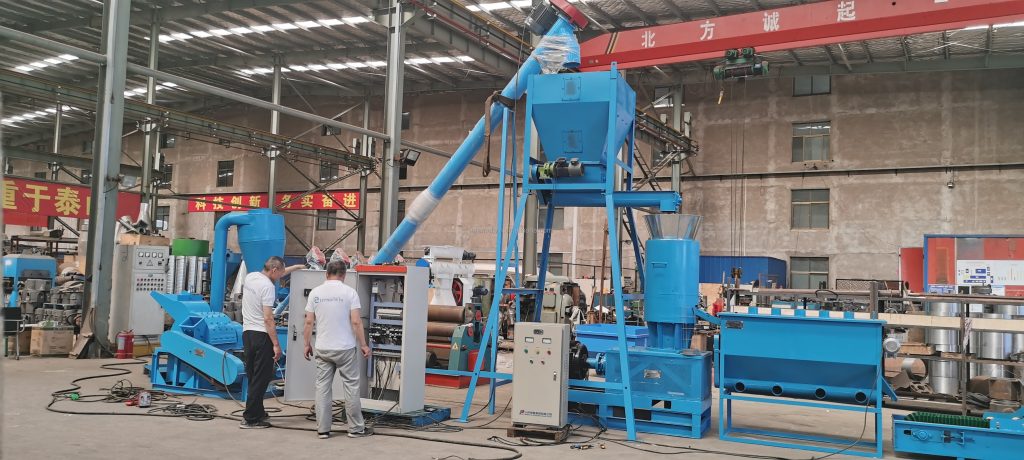
Producing feed pellets involves a sequential series of steps that ensure nutritional balance, proper formation, and quality.
First, a nutritionist formulates a feed recipe tailored to the specific nutrient needs of the target animal, ensuring it receives all necessary vitamins, minerals, and energy sources.
Next, ingredients are weighed according to this recipe: large scales are used for macro-ingredients, which make up more than 10% of the formulation, while small scales or manual weighing are used for micro-ingredients, which constitute less than 1%.
After weighing, the ingredients are ground to a particle size of less than 2 mm—this can be done either by grinding individual ingredients first (pre-grinding) or by grinding the entire mixture after weighing (post-grinding).
The ground mixture is then thoroughly mixed using a ribbon blender or paddle mixer, which can handle batches up to 10 tonnes at a time; pelleting aids and liquid-based ingredients are often added during this mixing stage to improve pellet formation.
The mixed material is then transported to the pellet press using a bucket elevator, which lifts it to the top of the mill and drops it into a bin above the press. Just before entering the press, the mixture is conditioned with steam in a horizontal mixing/transport chamber: the steam adds heat and moisture, softening the material to make it easier to compress into pellets.
The conditioned mixture then falls into the press, where it is forced through the die to form pellets; a knife on the outside of the die may cut the pellets to a specific length if needed. Once formed, the hot pellets are sent to a counter-flow cooler, where air is blown in the opposite direction of the pellet flow—this evaporative cooling lowers the pellet temperature to within 3–5°C of the ambient temperature and removes the extra moisture added by the steam.
Finally, the cooled pellets are transported via another bucket elevator to the top of the mill, where gravity moves them to storage facilities or packaging lines.