
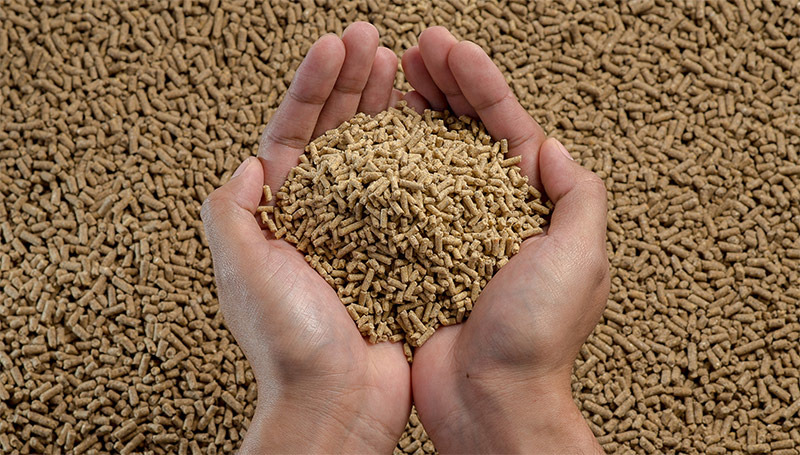
Several key factors work together to determine the physical quality of feed pellets, starting with the ingredients in the feed mixture.
At least some of these ingredients must act as natural binders—substances that hold the particles together—without which the pellets will easily fall apart.
The grind size of the ingredients is also critical: particles must be fine enough (typically less than 2 mm) to pack tightly together with no internal voids, as gaps between particles weaken the pellet’s structure.
Another important factor is the conditioning step with steam: the heat and moisture from the steam soften the feed particles and activate the natural binders in the ingredients, making it easier to form strong pellets during compression.
The amount of compression applied as the feed passes through the die is equally vital—sufficient pressure ensures the particles bond tightly, while insufficient pressure results in loose, fragile pellets.
Finally, cooling the pellets after formation plays a key role: reducing the pellet’s temperature and removing excess moisture “sets” the bonds between particles, strengthening the pellet and preventing it from breaking down during handling.
To help anticipate potential quality issues related to raw material choices, Borregaard developed the Feed Pellet Quality Factor (FPQF), a tool that predicts how well a specific feed formulation will perform during the pelleting process.